
Best Flight Comparison Sites: The Complete Guide to Finding Cheaper Flights in 2026
If you’ve ever spent three hours with fifteen browser tabs open, checking the same route on five different websites, only to watch the price change right before you hit “book” — you already know why flight comparison sites exist. They were built to solve exactly this problem: too many airlines, too many prices, and not enough time to check them all by hand.
But here’s the part most articles won’t tell you: not every comparison site works the same way, and picking the wrong one can actually cost you money instead of saving it. This guide breaks down how flight comparison sites really work, which ones are worth your time, and how to use them like someone who’s done this a hundred times before.
What Are Flight Comparison Sites, Exactly?
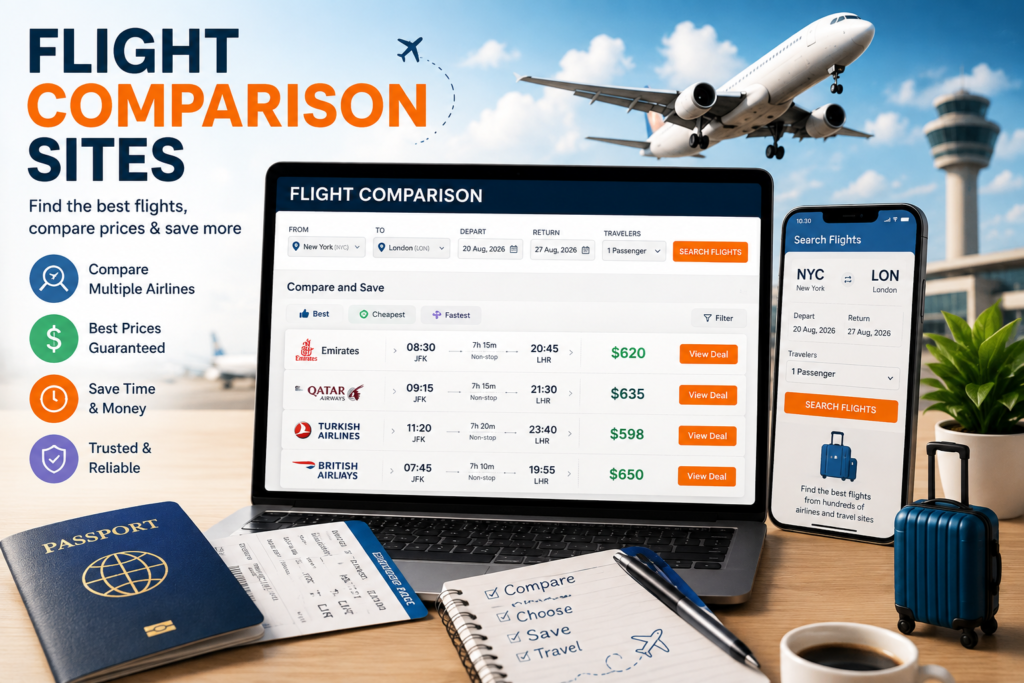
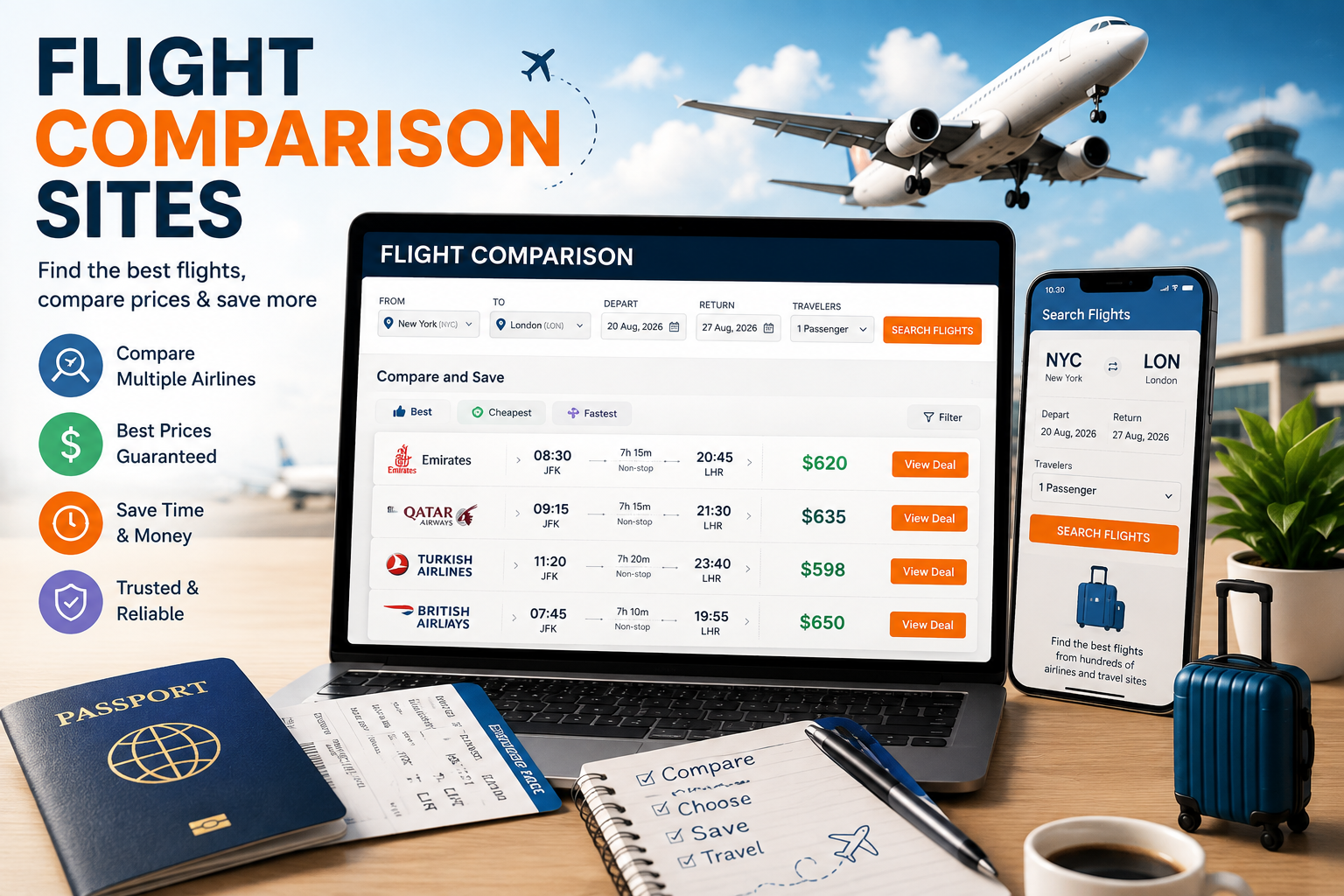
A flight comparison site is a tool that pulls pricing and schedule data from airlines, travel agencies, and booking platforms, then displays it all side by side so you can compare options in one place. Instead of manually checking Delta, then United, then Emirates, then a budget carrier’s website, you type your route once and see everything at a glance.
There are two main types, and understanding the difference matters more than people realize:
Metasearch engines (like Skyscanner, Google Flights, or Kayak) don’t actually sell you the ticket. They search across airlines and travel agencies, show you the price, and then redirect you to the airline’s site or a booking partner to complete the purchase. Think of them as a price-scouting tool, not a checkout counter.
Online travel agencies (OTAs) (like Expedia or Booking.com) let you compare and book directly through their own platform. They act as the middleman for the whole transaction, which is convenient but can sometimes mean added service fees.
Neither type is universally “better.” The right choice depends on what you’re booking and how much control you want over the process.
Why Flight Prices Look Different Everywhere You Look
This is the part that confuses most travelers, so let’s clear it up. Airlines use something called dynamic pricing, which means ticket prices shift based on demand, how many seats are left, how far out you’re booking, and even your search history in some cases. Add in the fact that different comparison sites pull data at slightly different times and from different sources, and you end up with three sites showing three different prices for what looks like the same flight.
This is exactly why relying on a single site is a mistake. A flight that looks fully booked on one platform might still show open seats on another, simply because their data hasn’t refreshed yet.
The Best Flight Comparison Sites (and What Each One Is Actually Good For)
There’s no single “best” comparison site for every situation — the right pick depends on what you’re optimizing for: price, flexibility, or convenience.
For pure price-hunting: Skyscanner
Skyscanner built its reputation on flexible date searches. If your dates aren’t fixed — say you just know you want to go “sometime next month” — its “Whole Month” and “Cheapest Month” views are genuinely useful. You can also search “Everywhere” as a destination, which is great if you’re chasing a deal rather than a specific city.
For a clean, no-nonsense interface: Google Flights
Google Flights doesn’t try to be flashy. It shows a price graph, lets you track fares over time, and sends alerts when prices drop on routes you’re watching. If you want speed and simplicity over bells and whistles, this is usually the first stop.
For bundling flights with hotels or cars: Kayak
Kayak’s strength is its “Explore” map feature and its ability to bundle flights with hotel stays or rental cars in a single search, which can sometimes unlock package pricing that isn’t visible when you search each piece separately.
For budget and last-minute deals: Momondo
Momondo tends to surface some of the more obscure, budget-carrier options that bigger platforms skip. It’s a good second opinion after you’ve already checked Skyscanner or Google Flights.
For booking directly with support included: Expedia
If you’d rather have one company handle your flight, hotel, and any changes afterward, an OTA like Expedia keeps everything under one itinerary and one customer service line — useful if your trip has a lot of moving parts.
The smartest approach, honestly, isn’t picking one favorite. It’s using a metasearch engine to scout the price, then checking the airline’s own website before booking (more on why below).
Why You Should Always Double-Check the Airline’s Website
This is a habit worth building: once a comparison site shows you a good price, go to the airline’s own website and search the same route before you complete the purchase. Here’s why this small extra step matters:
- Airlines sometimes offer the exact same fare directly, without a third-party booking fee.
- If something goes wrong — a cancellation, a schedule change — dealing directly with the airline is almost always faster than going through a third-party booking site’s customer service.
- Frequent flyer miles and loyalty points are more reliably credited when you book direct.
- Some airlines run promotions that don’t appear on comparison sites at all, since not every airline shares data with every platform (budget carriers especially).
Comparison sites are a scouting tool, not the final word. Treat the price you see as a strong lead, not a locked-in deal.
How to Actually Use a Flight Comparison Site Well
Knowing the sites is only half the picture. Here’s how to search in a way that consistently finds better fares, not just whatever shows up first.
Search in incognito or private mode. Some booking sites use your search history and cookies to adjust prices shown to returning visitors. Searching in a private browser window removes that variable.
Check nearby airports. Flying out of a smaller regional airport twenty minutes further away can sometimes save you significantly, especially on domestic routes.
Try one-way combinations instead of round trip. Booking two separate one-way tickets on different airlines is sometimes cheaper than a single round-trip fare, particularly for international routes.
Use flexible date search. If your travel dates can shift by even two or three days, flexible-date tools can reveal fare drops that a fixed-date search will never show you.
Set a price alert instead of checking daily. Constantly refreshing a search wastes time and, in rare cases, can even nudge prices upward due to demand tracking. A price alert does the watching for you.
Clear your cart, but don’t panic-buy. If a price disappears when you go to book, wait a few minutes and search again before assuming it’s gone for good — sometimes it’s a temporary system glitch, not a sold-out fare.
Common Mistakes People Make When Comparing Flights
Even seasoned travelers fall into a few predictable traps:
- Trusting the first price they see. The lowest number on the results page sometimes hides extra baggage fees, seat selection charges, or a longer layover than expected. Always check what’s actually included before comparing two fares as equal.
- Ignoring layover length and airport transfers. A cheap flight with a 55-minute connection at an unfamiliar airport can turn into a missed flight. Comparison sites let you filter by minimum layover time — use it.
- Forgetting to check baggage policies separately. Budget airlines in particular often show a low base fare that balloons once checked luggage is added. Read the fine print before assuming you’ve found the best deal.
- Not comparing currencies correctly. If you’re searching for an international flight and the site defaults to a different currency, small conversion errors can make a fare look cheaper than it actually is.
- Booking too early or too late. Domestic fares tend to be most competitive somewhere between one and three months before departure; international fares often benefit from booking a bit earlier. Watching a price trend for a week or two before committing usually beats guessing.
Metasearch vs. Direct Booking: A Quick Comparison
| Metasearch Sites (Skyscanner, Google Flights, Kayak) | Direct Airline Booking | |
|---|---|---|
| Price visibility | Compares many airlines at once | Only shows one airline |
| Convenience | Fast overview, redirects to book | Slower to compare, but complete control |
| Customer service | Depends on where you complete the booking | Direct line to the airline |
| Loyalty points | Sometimes not credited properly | Reliably credited |
| Hidden fees | Can be less transparent | Usually clearer upfront |
re flight comparison sites actually cheaper than booking directly? Not always. They’re best used to identify the lowest available price across airlines, but the airline’s own site sometimes matches that price without added booking fees. Use comparison sites to scout, then verify directly.
Is it safe to book through a flight comparison site? Generally, yes, especially with well-known platforms. The main thing to watch for is whether you’re booking directly through the metasearch tool or being redirected to a third-party agency, since customer service quality varies more with lesser-known agencies.
Why do flight prices change when I search multiple times? This usually comes down to dynamic pricing, real-time seat availability, and cached data differing between sites — not necessarily your search history, though clearing cookies is still a reasonable precaution.
What’s the best day to book a flight for the lowest price? There’s no single “magic day” that works for every route despite popular claims. What actually helps more is tracking a specific route’s price over a couple of weeks using price alerts, rather than trying to time one perfect booking day.
Do flight comparison sites include budget airlines? Not always. Many low-cost carriers opt out of sharing data with certain metasearch platforms, which is exactly why checking a known budget airline’s own site separately is worth the extra few minutes.
The Bottom Line
Flight comparison sites are genuinely useful — they save time, surface options you’d never have found manually, and make it far easier to see the full picture of what a route actually costs. But they work best as a starting point, not a final answer. Use one to scout the landscape, cross-check a second site if the price seems too good to be true, verify with the airline directly, and pay attention to what’s actually included in that fare before you book.
Done right, this process takes maybe fifteen extra minutes — and it’s often the difference between an average deal and a genuinely good one.
Are flight comparison sites cheaper than booking directly?
Not always comparison sites show you the lowest available price acrossairlines, but the airline’s own website often matches it without extra booking fees.
Is it safe to book through a flight comparison site?
Yes, on well-known platforms like Google Flights, Skyscanner, and Kayak just confirm whether you’re booking directly or being redirected to a third-party agency.
Why do flight prices change every time I search?
Because of dynamic pricing and real-time seat availability, not your search history — prices update constantly as seats sell.
What's the best day to book a flight for the cheapest price?
There’s no single best day tracking a route’s price for one to two weeks with price alerts works far better than timing one “magic” day.
Do flight comparison sites show budget airlines?
Not always many low-cost carriers don’t share pricing data with metasearch sites, so it’s worth checking the budget airline’s own website directly.
Chaho toh main blog post ke andar in FAQs ko is exact direct-answer wording se replace kar doon, aur schema code bhi update kar doon?